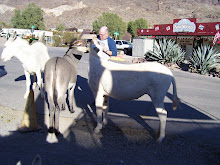
The kerfuffle started about 9:00 a.m. It was a crappy morning outside -- wet and dreary. As per usual, I fed The Happy Dog breakfast and his morning treats. Seeing the wet landscape, I told The Happy Dog we would wait a but before tending to the morning walk.
At first, The Happy Dog seemed to understand this concept. I guess that he, too, could see it was raining cats and ... whatever ... outside.
So I set up the laptop in the dining room and began to delve into the morning emails. Suddenly, I was aware of some flailing feet and low moaning. I walked around the table and, saw, to my horror, The Happy Dog on his side shaking uncontrollably. I yelled at Lynne to get the vet clinic on the phone immediately and rushed to my friend's side.
Many years ago, I worked at a camp where we had kids who were subject to epileptic seizures. I remembered the key to dealing with them was keep them calm and make sure they didn't hurt themselves. So I tried to talk softly to The Happy Dog and petted his back. The seizure continuse. Although they probably only ran for 15-20 seconds, it seemed like minutes. I saw some red liquid shoot out of his mouth. Some foam followed. In all likelihood, he simply bit his tongue. But it was a mess.
In time, The Happy Dog calmed down and looked dazed. He, too, probably wondered what the hell just happened. We got the vet on the phone and the nurse said to get in there right away.
By the time we got there (it's only about 5 minutes away), The Happy Dog appeared to be back to normal. But he had to pee and poop like Secretariat. Even though it was still raining cats and ... well, you know ... the need for a good P & P trumps everything else. THD did his duty and gratefully ran inside the vet clinic.
A nurse came, suggested a room off the lobby with a nice carpet, and gave him some water. Dr. Casey took a look, checked out some vitals and immediately ordered up blood tests. 75 minutes after it had started, The Happy Dog was back home and seems back to normal.
What happened? What caused this aberration? Is this the start of something serious or was this an unusual reaction to the anxiety of not getting out for a walk at the usual time? We may get an answer tomorrow when we get the blood tests back. In the meantime, I now have a brochure as to what to do if a future seizure occurs. And I am suddenly nervous about leaving the house for 90 minutes to have lunch with a (human) friend.
For now, he appears to be fine. It may well have been a one-time only thing, a blip on the health radar. I can relate to that. But I also know that all blips on the health radar run the risk of potential future consequences. We will be watching The Happy Dog a lot closer from now on.
Although we don't think of animals this way often, the incident had to be terrifying for him, too. So, I was happy to be there to calm him down and be at his side in a moment of crisis.
And that's the point. If you saw a friend have a seizure, you would likely rush to help that person. You would comfort that person and his/her family the best you could. You would get them to a doctor or call for an ambulance. And you would not think twice about staying with them as long as you felt necessary.
So it is here. The Happy Dog has been a member of the family for nearly nine years. Frankly, I know he is getting up there in age (he'll be nine in June). There will be a time (hopefully, way down the road) where Lynne and I will likely have to make a difficult decision as to his future wellbeing. But, right up to that moment, he deserves our best level of attention possible.
In other words, we will do for him what we hope someone would do for us if the roles were reversed. Yes, it costs money to go to the vet. And money is tight now. But The Happy Dog has always been loyal to us. Seems to me that (within reason, of course), this is our time to be loyal to him.
That's probably too mushy for some people. For others, it probably sounds ridiculous. But, to animal owners and lovers, it makes sense. The Happy Dog may not be a friend in the same sense as the old pal I am meeting for lunch today. But he is a friend. And I was taught years ago to come to an aid of a friend no matter what kind of help is needed. And that does make sense to me.
Tuesday, April 26, 2011


Saturday, April 23, 2011
"The King's Speech" is a great movie ... and more
Just got around to watching "The King's Speech" yesterday. If you haven't seen it yet, you need to. It is an important story that is very well told. We tend to mock royalty these days. Most of the reason for that is, here is the lower 48, the concept of royalty seems odd to us.
But it doesn't to the Brits. The men and women who have taken on those roles may, indeed, have all the money a person will never need at his/her disposal. But they also carry a burden - namely, that every action they take is subject to a country's scrutiny. That means if you have any sort of handicap (and I think we can agree being a stutterer is a handicap), you will be subject to considerable ridicule.
The movie has great acting ... and is worth seeing just for that fact alone. But it also is a triumph of will, guile and plain old-fashioned guts. At some point in our lives, we all have had to reach out for help. More times than not, that helps come from an unlikely source. (In this case, a commoner who wasn't even a doctor.)
My favorite moment of the movie comes at the end. It is when the King is done with his important speech. On his way out to greet his subjects, he stops to simply say, "Thank you" to the man who stood by his side during what was likely the biggest personal crisis in the King's life. It would have been easy to forget to do so. But great men get that way by not forgetting the little things.
Sunday, April 17, 2011
Farewell, MISTER Bertoia
It was during the first week of the 1968 school year. I had transferred into Assumption High School as a sophomore. I was trying to impress my new comrades in the back row at the start of History Class. So I told them some joke I had heard. There were several guffaws, which got the attention of The History Teacher, who stopped his writing on the blackboard.
"Perhaps you might want to tell us all what is so funny, Mr. Wright," said The History Teacher.
I stammered a bit and repeated the joke. The silence in the classroom was deafening. The History Teacher looked at me quietly and said, "That wasn't worth the time, Mr. Wright." And then he proceeded to start the lesson.
After class, The History Teacher pulled me aside, saying "Tomorrow, we start over, okay? We all have bad days."
The History Teacher was Reno Bertoia, a gentle soul who passed away the other day at age 76. What I didn't know then was he was a man of many talents who saw things in kids they didn't see in themselves. Most of us simply knew him as Mr. Bertoia, the fellow who assisted Father Cullen with the baseball team and taught a crackerjack, lively history class. What most of us didn't know was he was a rarity, a native of Italy who played 10 seasons in the major league. And he was no run-of-the-mill assistant baseball coach. No, Mr. Bertoia knew the game inside out and chose to teach us baseball the way he learned it -- one lesson at a time.
That fall of 1968 was a memorable one. The Detroit Tigers, who served as Mr. Bertoia's main major league employer (7 of his 10 seasons were as a semi-regular third baseman) had rolled over the American League field to win their first pennant in 23 years. They clinched the pennant on a Tuesday night. The next day, they got rained out so they had to play a makeup game on Thursday against the Yankees. Mr. Bertoia marched into class and asked who would like to go to the Tiger game that afternoon. The codicil was we had to behave ourselves or we would regret it forever. Half a dozen or so went with Mr. Bertoia. I learned as much baseball during that meaningless afternoon game as I had during my whole life.
This was the famous game when Denny McLain, cruising to his 31st victory, gave Mickey Mantle a meatball for a pitch that was hammered into the upper deck in right field. Mr. Bertoia said he didn't like the idea but, considering the score (Detroit led 6-1) and all that Mantle had done for the game (this was his last game in Detroit), an exception could be made. "You have to respect the guys who made the game great," he said. "He did a lot for the game. I guess it was time the game did something for him he'll always remember."
The next day in class, Mr. Bertoia then ordered all of us who had been there at the game to write down everything we remembered about it. It was my first lesson in reporting. "You guys saw history yesterday," he said. "Now put it down in words."
A couple of weeks later, Detroit was playing St. Louis in the World Series. We watched the games either in Mr. Bertoia's or Father Cullen's classroom. But they wanted more than you to be fans. They wanted you to remember what you had watched. So, there were questions asked each day about the previous game. Good teachers use different methods to get kids to think.
The following spring, I decided to tryout for the baseball team. After watching about three swings, Mr. Bertoia pulled me aside. "If you are going to have that slow of a bat, you better learn how to bunt," he said. I never did learn how to hit but I could bunt with the best of them.
In time, we got to know each other better. He knew I had spent a lot of time as a youth with my uncle in Dayton, Ohio. My uncle had been my first baseball instructor. By 1970, he was retired but he was still a big Cincinnati Reds fan. Mr. Bertoia came up with two prime tickets for Game 2 of the 1970 World Series between Baltimore and Cincinnati. A drawing was held. Amazingly, the fellow who had a distant cousin play for the Reds was able to take his uncle to see his first World Series game. I have always suspected the raffle was akin to the famous one in the initial episode of M*A*S*H. (The one where Father Mulcahy is declared the winner of a date with a nurse).
All Mr. Bertoia said was, "I better get a written report on the entire day." He did. Later that year, he pulled me aside again. "Do you have a summer job yet," he asked. I told I hadn't. "Good," he said. "I suggest you spend the summer at Columbus Boys' Camp as a counselor. It will be a great experience." CBC was a camp in Orillia, Ontario run for kids from the Toronto area who would not have gotten a vacation otherwise. It was such a great job that I came back for four more years, including two as Evening Entertainment Director. It was the most rewarding job I ever had ... even though my top pay was something like $600 for the summer.
Fast forward two more years. I was considering colleges. I had received some information about a small school called St. Thomas in a far-off place called St. Paul, Mn. One day, Mr. Bertoia found me in the hallway. "Hey, I just thought you should know that some of the nicest people I ever met were during the two months I played in Minnesota," he said. "It's a great place and they will treat you well." What I didn't know was he called the hockey coach there (Gus Schwartz) and recommended I get hired as a manager/public address announcer. (I had been doing Assumption's games at Windsor Arena.) I also didn't know he called the head of the school's burgeoning Journalism Department to give me a recommendation as a student "with potential. But he needs to get his butt kicked occasionally." Father Whalen, who founded the department, agreed ... at least with the latter idea.
Last year, I gratefully acknowledged his help in inspiring my book on the Twins "162-0." I sent him an inscribed copy as a thank you. He sent a note back saying he appreciated getting the book, adding "Hope your joketelling is now as good as your writing." Man never forgot, did he? But he did forgive.
We all have high school teachers in our lives who made a big difference, I only took one class from Mr. Bertoia. Truth be told, our paths didn't cross all that often afterwards. But I always remembered the little lessons he taught me. And I wasn't alone. A few years ago, I was in Windsor for a couple of days. My wife and I went out to dinner at a place that had a piano player. During one of the player's breaks, we were chatting. I told him where I had went to school. "You're one of Reno's boys, aren't you?", the piano player said. "Isn't he a great man?"
Yes, he was. To me, however, he will always be MISTER Bertoia. May he rest in peace.
Thursday, March 31, 2011
Indeed, Time (or at least Spring) begins on Opening Day
Today is the day that a friend of mine, a non-baseball person, struggles with the most. Today is the official start of the 2011 baseball season. There are a half dozen games on tap across the land. People will smile a little more today. I can't tell you why for sure. It just is.
In theory, this should be no big deal. After all, the season lasts 162 games. What's one game against that backdrop? But what my friend doesn't realize is that Opening Day is like the bear waking up from his winter snooze to go outside his cave again. Even if we head to the ballpark in a parka, we know that we soon won't need them anymore. We know that everybody from the world champ Phillies to their obscure neighbors the Pirates start even today.
Opening Day is about hope more than anything else.
I only went to one OD at Tiger Stadium. In retrospect, it was a rather tame, unmemorable affair. The Yankees beat Detroit, 3-0. As was his wont, Mickey Lolich pitched the whole game but his teammates offered tepid support. I sat in the upper deck behind home plate and remember it was cold but sunny.
But, as often happens, there were some unusual happenings. Gary Sutherland, a foot soldier who managed to play a dozen years in the bigs despite hitting only .248, had four hits that afternoon. Roy White, who was a helluva good outfielder for years for the Yankees, was the dh for the first time in his career. (I looked it up. White played 1600+ games in his career and only DHed about 100 times.) It was also the last Opening Day for Detroit's peerless Al Kaline, a once great right fielder who was now a fulltime dh.
I don't remember many games I went to at Tiger Stadium when the locals lost but I will always remember that one.
Upon arriving here for college, I went to a couple of Opening Days at Met Stadium. On one of them, Nolan Ryan pitched for the Angels. There was snow stacked up outside the stadium and only 13,909 attended the game. Ryan threw rockets past most of the Twins on a day when it couldn't have been 45 degrees. I remember Glenn Borgmann, of all people, drilled a bases-loaded double off the center field fence. But that was it. Angels won (7-3, as I recall). We wore parkas but still had a blast of a good time. it was just fun to be outside after a long winter.
Opening Day IS a big deal. Indeed, The Voice Of The Turtle can be heard (or at least imagined) again. The sun will stay out a little longer. People will smile a little more than usual. I feel bad for folks who -- even the non-baseball fans -- who don't get this concept. I don't claim to understand all of the reasons why Opening Day is special. I simply know it is.
Thursday, March 24, 2011
Small town bb is fun
My friend Tom Elliott, who covers preps for the St. Cloud Times, threw me an accosting look yesterday. "Your sports blog has been headed in different directions lately," he said.
I started to protest that I said in the first effort that a lot of what goes on here would not have a lot to do with sports. But there are times where it is time to return to one's roots.
So, Tom, I hope you read this one. This is one of those times.
About a month ago, I rhapsodized about the pleasures that come with section hockey week. Today is another happy missive. This time, the subject is the MSHSL Class A boys' basketball tournament.
For the first 57 years of its existence, Minnesota had a one-class BB tournament. In 1970, it went to a two-class event. 25 years later, it was expanded to a 16-team event. Two years after that, they went to the current four-class format. While the majority of games are played at Target Center, 10 first round games are played at creaky Williams Arena, the home of the University of Minnesota basketball teams since 1921.
The Class A teams play their quarterfinal games here. The last several years, I have been assigned the p.a. duties for two of those games. It is about as much fun as you can have for four hours on a spring afternoon.
When I walked in, a team called MACRAY, an amalgamation based in Clara City in southwest Minnesota, was in the process of taking apart a local school. A skinny 6-7 senior named Seth Hinrichs, who is headed for Lafayette on a hoop scholarship, was busy making shots from everywhere. (I wonder how Lafayette, which came one game from going to the NCAA tournament this year, found him. The small school is located in Easton, PA - not exactly on any beaten path from Minnesota.)
As this happened, the crowd of 3,000 or so seemed to be coming out of their socks with joy. MACCRAY eventually won and will be staying in town for the weekend.
Now it was my turn to go to work. In the first game, Chisholm, a small town in northern Minnesota, took on Fosston. The Chisholm coach is a fellow named Bob McDonald, who has only been on the job 56 years. Chatting with him before the game, one might have thought he was in his first year. "You never know how kids are going to react, do you?", he said. "We played well in the sections. I don;t have a feel for whether we will do so today."
McDonald's kids all look the same -- young, lean with short hair. If you didn't know better, you might have thought you were watching a scene from the movie "Hoosiers." They call officials "sir" and, when asked, go back to their benches to wait to report in as a sub. But these kids are no rubes. Adam Vake, a 6-3 forward with a very nice touch and a huge hunk of a center named Sioka Latu were simply too much for Fosston to handle. The Bluestreaks played some nasty defense and won solidly, 51-39.
It was a fun game but it paled compared to the second game which pitted Springfield against Upsala. Springfield, located in the southwest corner of the state, boasts a population of 2,215. That makes it a booming metropolis compared to Upsala, which listed a total of 424 residents in the 2000 census.
"But it has a barbershop, a post office, a bar, a gas station and a grocery store. They also have a new gym," Elliot informed me. (The hamlet is in the SC Times coverage area.)
Both schools had marching bands that would be right at home in the Rose Bowl Parade. Just about Class A school has one like that. At Williams, we sit below the crowd. So, the bands sounds as if they are coming out of the skies. Trying to talk over them is trying to talk over the women of "The View." After a while, you simply give up trying and learn to wait them out.
There appeared to be nobody left in either town by gametime. The Springfield section behind me made a constant racket. I was distracted early by a fellow who seemed to believe the officials (none of whom came from anywhere near either city) were engaged in some sort of criminal conspiracy against his Tigers. At one point, he hollered, "You guys owe us eight calls." This would establish a new record for even upness.
As it develops, the enthusiasm occasionally went overboard. The first Upsala free throw of the afternoon was greeted with a shrieking airhorn, a definite no-no at prep games. The conspirator, however, must have been given a hint. He did it once but never repeated it. At halftime, a security guard told me he knew where the general direction where the perpetrator was hiding. Apparently one nasty look is enough at these games.
These may be small schools but everybody, it seems, has some big boys on it. Springfield's big fella is Tyler Marx, who is 6-8 and is built like a mountain. At one point, he simply glared at an Upsala shooter, who decided it was time for a pass instead of a shot.
The Cardinals may come from a small town but they made some very big plays to keep the game close for a long time. A freshman named Christian Pekarek caught my eye early. He dove for a loose ball and ended up off the raised court out of view from all of us. He emerged seconds later smiling. Later in the first half, he dove for a ball and crashed directly into the on-court possession clock, making a dent in it that looked like it had been hit by a baseball bat. He landed on top of me and Ron Cadwell, who was helping handle the official scoring. He also flattened a water bottle that drenched the official scorebook. Fortunately for your Mr. Pekarek, I was able to brace his fall and keep him from bouncing off a railing behind me. Ron and Kingsley Wilson, the official scorer, were not so lucky. Ron spent the rest of the game with ice on his hand and Kingsley needed a bandage to close his wound.
The small school kids play for keeps here. (Don't take my word for it. Go to the Friday St. Cloud Times website and check out the pictures from the game. Great stuff.)
Pekarek was not done. Later, he ended up in a pile behind the Springfield bench and nearly landed in the band section at the end of the court. While on the court, he made some great passes and a a few good steals. "If he lives to be a senior, he'll be a helluva player," one guy noted. My own view was there must be no walls in the Upsala gym.
The action wasn't always highly skilled. But it was always highly intense. Bodies flew everywhere all game. "We had more guys fly off the court in this game than we have seen all season in college games," said one Williams worker. At one point, I spotted Upsala coach Vern Capelle, who has only been on the job for 25 years, jumping high in the air to get his team's attention to call a timeout. (In case you're wondering, Class A coaches do not have show contracts. I remember a few years ago one head coach stopping in the middle of his timeout discussion to tie his shoe. He got up and said "Now where was I? Oh, yes, now you have to cover ...")
There was one point in the second half where, with the game still in doubt, the entire Springfield bench closed their eyes as Upsala took a free throw attempt. They only opened them when the crowd roared behind them the shot was missed.
Later, I recorded another bb first. Cody Milbrath, perhaps Springfield's best player, had to depart the game at one point because he somehow managed to get blood on his back. It required him to change jerseys with Shawn Anderson, a sophomore who apparently wasn't going to see the light of day. I've seen a lot of blood on players but never a cut on the back. Have no idea how that could have happened.
On the court, Upsala hung in there as long as it could. But Springfield was a little bigger and, frankly, a little better. A 5-9 guard named Jesse Kieper nicely complimented Milbrath, who is 6-5 and the aforementioned Marz. Eventually, this wore the Cardinals down for a 10-point win. But such is the small town pride that, when, as part of the post-game ritual, it was announced that Upsala ended the year with a 25-4 mark, their crowd stood up and cheered one last time.
Everything moves to Target Center from here. That's somewhat understandable. After all, playing in a NBA arena has to be a juicing experience.
But there is something magic about the Class A games at Williams. Granted, the winners would probably get waxed if they played Hopkins, the big school power who is favored to win another AAAA crown Saturday night. There were some awkward moments near the rim and a few three-point attempts that were better left untried.
But that's off the point. High school athletics is, in part, about the chase. In this case, you have small towns who often face an opponent they know nothing about. (In many cases, it is a town they never heard of.) So they simply go about and run the plays they have done all year The fans yell their lungs off (even if they do make idiots of themselves on occasion.)
It is not always artistic basketball. But it is fun to watch and very intensely played.
That's what it is supposed to be about, right?
Tuesday, March 22, 2011
Goodbye, Lefty
This getting older business has its good and bad sides. One of the good is the older you get, the quicker you are to recognize nonsense when you see and hear it. Yes, we still get fooled by people on occasion. But it is not as often as when, say, you are 25 years old.
The bad is you have to say goodbye forever to a lot of people you liked very much ... even if you didn't know them all that well. I noted last week the passing of one of those guys, Glenn Gostick. Today, it saddens me even more to note the passing of Dan Carey.
Not that this was unexpected. No, we knew this day was coming for 13 months ... even since it was discovered (via a CT scan) that Dan had a brain tumor.
But I hoped against hope this new treatment Dan was undergoing would somehow produce a miracle and we could resume our friendly discussions about baseball and life in general.
Like Gos, I didn't know Dan that well. (For example, I never knew his nickname was "Moose" until he went into the hospital.) I would run into him most of the time at St. Thomas athletic events (he was a professor there). We talked often about his days as a Mets minor league farmhand. Since he had been a left-handed hurler himself, Dan was very knowledgable about what made (and did not make) a good pitcher. Occasionally, the conversations drifted into other areas but, for the most part, baseball was our topics.
But there was something else about Dan that I found quite remarkable. He had the amazing ability to disagree with you on a subject without being disagreeable himself. I discovered he was a fellow who despised conflict. He thought it was basically unnecessary. Most disagreements could be reasoned or discussed out. I only saw him upset once. A student who thought he deserved a better grade had come into Dan's office and yelled at him long and hard about it. Dan was genuinely puzzled as to how the student could really think this would get him to reconsider his decision. To Dan, you could have strong opinions -- even sharp disagreements -- without turning into one of the screaming folks you often see on cable television. It didn't make sense to him at all.
There are those who knew Dan Carey much better than I did. I am sure they probably feel a deeper sense of personal loss than I ever could. But I found myself in church Sunday lighting a candle to him and saying a silent prayer. And I will go to the funeral home tonight and pay my respects ... even I don't recognize a single person there (I know he had a couple of siblings. But I have never met them.). Fact is, Dan Carey was one of the nicest, kindest people I have ever met in my 57 years, 10 months and one day on this earth. It is a pleasure to say so publicly.
I find myself hoping that Dan knew I (and many others) felt this way about him and whether that was a comfort to him in his final days. I want to think so.
But it makes a fellow wonder, though. Is there anybody out there who feels that way about me? If so, what did I do to deserve such high praise? If not, is there anything I can do to change people's opinions?
Thursday, March 17, 2011
The one ... and only Gos
"K is for Keeler,
As fresh as green paint,
The fastest and mostest
To hit where they ain't."
That is one of the verses of Ogden Nash's 1949 poem: "Line-up for yesterday: An ABC of Baseball Immortals." Glenn Gostick, who was found dead in an apartment in Colorado yesterday, used be recite that stanza ... and the 25 others in Nash's poem by heart.
Gos was 83 and, I suspect, went out with a smile on his face. I hadn't seen him for many years but I am still a bit saddened by his passing. You see, Gos was one of last of a dying breed. He was an American original who did things his way.
He had no phone at his house in Minneapolis. I am not sure he drove a car. Yet he was one of the most informed people I ever knew. He had one of the best baseball memories of anybody I ever knew. I had been told this was the case when I met him. I decided to give him a test.
"Arlo Brunsberg," I offered tentatively.
"One of the very few Minnesotans who made his debut in home state," Gostick replied with annoyance. "Lined out to shortstop off Mudcat Grant. Went 1-for-3 in his career."
I only knew this because Brunsberg's brief career was with the Tigers. Indeed, Brunsberg, who was born in Fertile, MN only appeared in one more big league game, getting a hit off Paul Lindblad in the bottom of the ninth inning in the last game of the 1966 season. Had I asked, I am quite sure Gos would have told me that fact, too.
I didn't know very well. But I was always charmed by him. He umpired baseball well into his 70s, running a brisk game in which he expected players to be respectful and hustle.
For a while. he served as an official scorer for Twins' games. But that didn't last long because Gos expected major leaguers to make major league plays. A half-assed effort on a ground ball earned you an error in Gos' book. The big leaguers didn't cotton to that much and Gos was soon back umpiring and poring over statistics.
Their loss, he figured. He was right on that one, too.
He was adamant in his view that most sacrifice bunts were a waste of an out, offering up a study a Yale professor did in the early 1960s as evidence. He had equally strong views on Hall of Famers. He definitely thought Don Drysdale, for example, was undeserving of the honor and rode in on his charming personality and the fact he followed Sandy Koufax to the mound for several years.
To Gos, it was always about the numbers. They told the stories of most baseball games.
He was a trainer for years, working with Dick Siebert and the U of M baseball team and later, the WHA Fighting Saints' hockey team. he took the job seriously, often leading the charges on runs himself. Gos did nothing at half-speed. He liked it that way and couldn't understand that others didn't. (Or at least he pretended he didn't understand.)
The bottom line was simple: here was a man who, in Sinatra's words, did it his way all the time. How many of us get to say that today?
Subscribe to:
Posts (Atom)